How Structure from Scratch works
Imagine if you could sit next to a couple of MBB consultants and learn to structure different case questions until you’ve internalized the nuances of how management consultants structure their problems and could do it yourself.
Of course, Julio and I can’t sit and personally guide each person who wants to improve their structuring.
But we’ve created something BETTER than that.
See, our coaching packages start at $500/session, with a minimum of 10 sessions…
…So even with our coaching clients, we don’t have the time to carefully explain the logic behind structures. It’s straight to practice and feedback.
In this program, we have time. We have breathing room to carefully explain the logic behind structuring, and the different types of cases and structures.
We have the time to teach you every structuring technique we know of (many of which we developed ourselves), and show you tons of examples and counter-examples.
Above all, we have the time to practice. A LOT.
In Structure from Scratch, we show you our whole system to structure cases quickly, intuitively and in a customized way.
And you get to practice with us at your own pace, as your schedule allows.
(In fact, being able to do a ton of practice on your own, without paying a coach or having to schedule with other candidates is one of the key reasons people join this program.)
We’ve created this program so that it’s the equivalent of getting 30-40 hours of coaching with us.
And we’ve made sure it’s as close as it gets to getting personalized guidance from us.
Learn the 4 Types of Cases and the “Algorithm” to structure each one of them
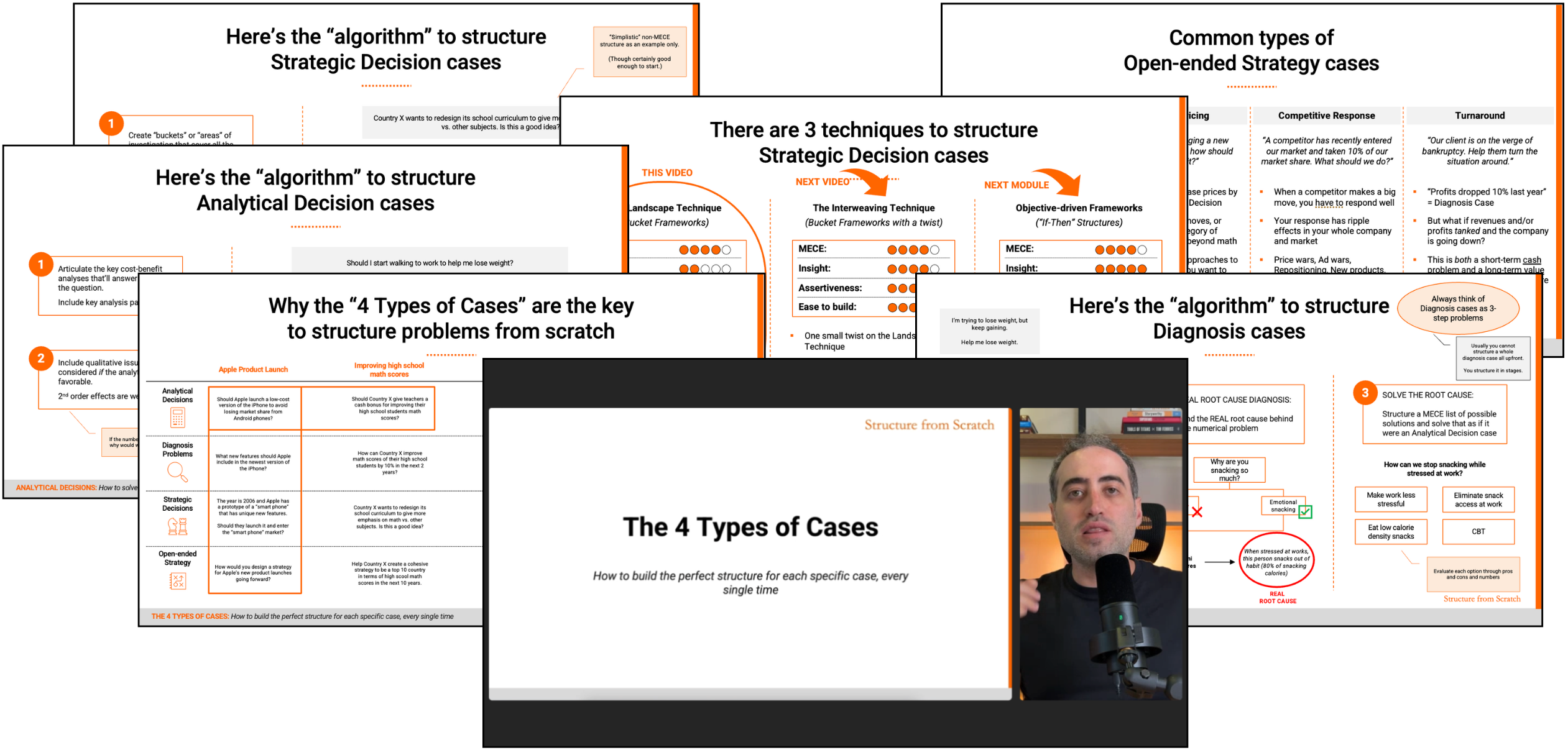
Everyone learns that you structure cases based on “case type”:
- “Use this framework to ace your Market Entry cases”
- “This is the proven way to structure M&A cases”
- “Never forget doing this in your profitability cases”
The problem?
This never works. You’re almost sure to get a public sector case, or a weird business case you’ve never seen before (like a “white-labeling” case), or even a combination of two common case types.
In this course, we’ll prove to you that this approach is dangerous, and we’ll offer you a different approach.
An approach that, instead of focusing on the “type of decision”, focuses on the underlying structure of the problem itself.
We call this “The 4 Types of Cases”, and each of these types of problems has different underlying logics — and different ways to structure them.
Two “Market Entry” cases, for instance, can be of different types.
One may be an “Analytical Decision”, while the other may be a “Strategic Decision”, for example.
And if so, their structures will follow a completely different logic, approach, and prioritization.
In this course, we’ll show you how to identify each type of case, we’ll show you the “Algorithm” to structure each, and we’ll teach you the techniques you’ll use to structure each one of them.
The goal here is that you’ll stop memorizing frameworks and reciting them blindly to your interviewer.
Instead, you’ll show them you can think about the logic of the problem in the same way they do.
Learn the beginner and advanced techniques real consultants use to structure their clients’ problems
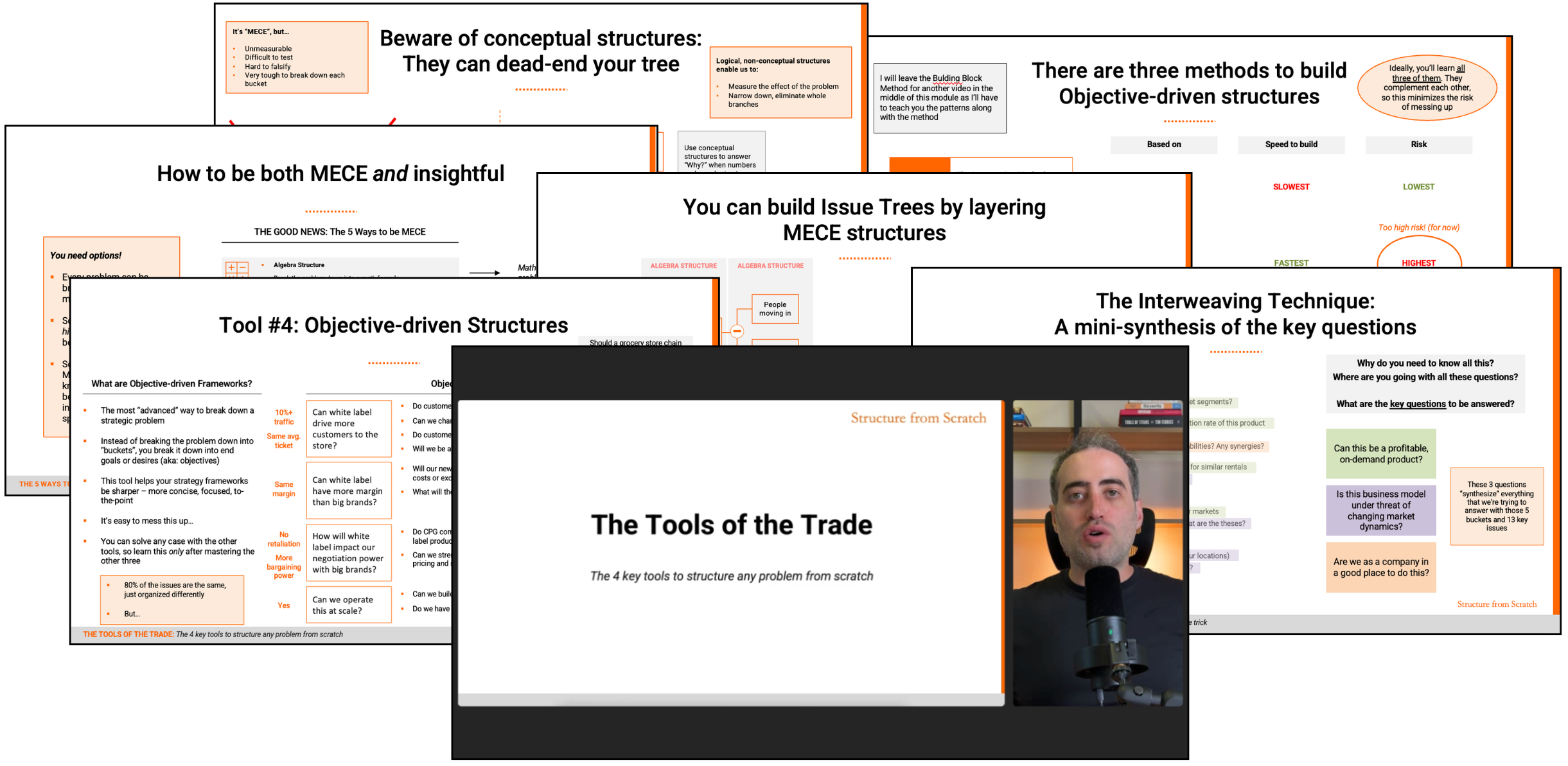
To structure well, you need to go beyond the tactics and the techniques.
You need to understand the different underlying structures problems have and the system to structure each…
…But you do indeed need to learn the techniques.
We’ve PACKED this course with structuring techniques.
You’ll learn, in-depth, the key structuring techniques, like “The 5 Ways to be MECE”, “MECE Issue Trees” and “Bucket Frameworks”.
(These are the ones you should master so you even have a chance to get the offer.)
But you’ll also learn advanced techniques, including:
- The Interweaving Technique: An easy-to-learn, fast way to make your “Bucket Frameworks” (or Conceptual Structures) 2X sharper and more to the point (this is the easiest way to differentiate yourself in strategy cases).
- Objective-driven Frameworks: We’ll show you how to structure complex cases like real consultants do — not through “buckets” to gather information, but through “Key Questions”, or “Key Hypotheses”. This technique alone allows you to solve complex MBB cases 2X faster, because you cut all the BS from your frameworks.
- Option Trees: A special type of Issue Tree that’s rarely used by candidates, but often used in projects and that’s useful for structuring cases that should be framed through an “Answer First” approach (we’ll show you how to identify that as well). Option Trees are especially useful for Revenue Growth cases, Competitive Response cases and Corporate Strategy cases.
Besides these three advanced techniques (that no one else teaches), we’ll also teach you:
- Advanced Brainstorming techniques (like the “Pivoting Technique” to brainstorm hundreds of ideas at the speed of speech).
- The best tactics to do Hypothesis Testing effectively (The “Cheap Test” Method is just one of them).
- Niche structuring techniques that are useful for final-round cases (“If-then Frameworks” is one of them, very useful for ambiguous problems that must be solved in a short amount of time).
Practice 50+ drills to actually improve your structuring skills (and vastly improve your Business Sense at the same time)
 You’ll watch me creating structures IN REAL TIME, just after you’ve built yours
We’ve embedded tons of high-quality video practice drills in this course, as we do in all our courses.
We could teach you all the theory you want in this course, but would this actually improve your performance when interview day comes?
I wish, but probably not.
Solving cases is not something you learn from a textbook. It’s a skill you need to hone through practice.
We’ve added 50 Framework drills in this course, covering each of the 4 Types of Cases and every single technique we teach.
These Framework drills are in video format and all follow the best structure we’ve found for solo practice:
- You’ll get a case question, pause, and try to structure the case following the specific system and techniques you’ve learned in that module.
- Then, you’ll watch us structure the case as we would in a real interview (including the communication style).
- Finally, you’ll watch us debrief that structure and comment on best practices and common mistakes. (Here’s where you’ll improve your business sense.)
 Practicing is good. But being debriefed in detail after each practice session is what leads to true greatness.
These drills cover countless industries and public sector problems and cover all types of decisions (or “case types”, as commonly known) you can think of, including:
Profitability, Market Entry, Market Exit, Revenue Growth, Private Equity, M&A, Pricing, Turnaround, Competitive Response, Operations, Capacity Expansion, Infrastructure, Franchising, White-labeling, Verticalization, etc., etc., etc.
(And yes, we have multiple Public Sector drills, including Education, Public Health, Sanitation, City Transit… You get the idea!)
But that’s not all…
You’ll also get dozens of drills specifically for Brainstorming and Hypothesis Testing.
These are incredibly important types of structuring questions that candidates (and casebooks) give little attention to.
A big mistake!
In fact, while each case has at most one Framework question, most cases have anywhere from 2-4 Brainstorming questions and another 2-4 Hypothesis Testing questions.
You won’t find these questions in casebooks because they’re often informally asked by your interviewer.
They don’t seem like “official” questions, but you ARE being evaluated.
While the Framework question gets all the attention (since it’s usually the first question of the case), a large part of your structuring evaluation happens in these two other question types that no one talks about and no one practices for.
Master Brainstorming and Hypothesis Testing
So, let’s talk about these types of questions.
About 80% of this course’s content focuses on building Frameworks, or initial structures for your cases.
That’s because Frameworks areharder to build (since their purpose is to structure more complex questions), and arguably more important too (they set the stage for the case — and your interviewer’s initial impression of you).
However, you can’t say you can structure any problem from scratch if you haven’t mastered Brainstorming and Hypothesis Testing questions.
In this course, we’ll show you the basics of structuring Brainstorming and Hypothesis Testing, PLUS we’ll show you advanced techniques for them.
But most importantly, you’ll master them through a lot of practice.
While Frameworks are more complex and really do need a complete system to be mastered, the best way to master these other two types of structuring questions is through practice.
High-quality practice, and with enough volume.
Which is what you’ll find in this program.








You must be <a href="https://wislibrary.net/my-account/">logged in</a> to post a review.