

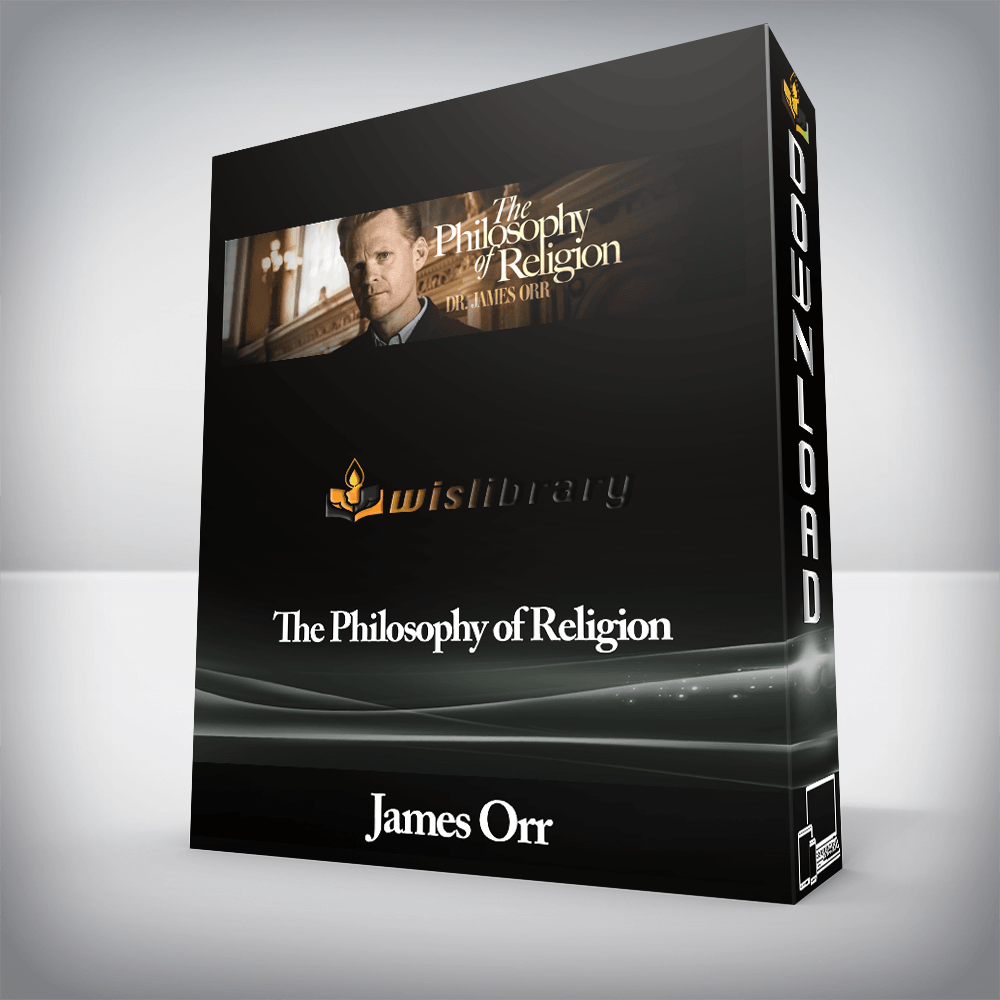

In The Philosophy of Religion, an eight-hour course, Dr. James Orr offers an examination of the philosophy of religion through cognitive, moral, and experiential dimensions across major religious traditions. Together, we examine classical arguments for God’s existence including ontological, cosmological, and teleological proofs, alongside non-traditional arguments from consciousness, morality, and information. The course addresses fundamental challenges like the problem of evil, the Euthyphro dilemma, and the nature of religious experience, concluding with an analysis of how religious frameworks uniquely address the modern meaning crisis by providing narrative unity and answers to existential questions.

In our introductory lecture, Dr. Orr opens our study of the philosophy of religion by exploring fundamental questions of existence, meaning, and divinity across philosophical and religious traditions. We examine the rise of sophisticated religious thought during the Axial Age (8th–4th century BCE), when civilizations independently developed complex frameworks such as Confucianism and Daoism in China, Vedantic philosophy in India, and Abrahamic monotheism. The lecture also addresses key philosophical challenges, including the nature of ultimate reality, the relationship between God and creation, and the limits of human language in discussing the divine.

In lecture two, we explore the classical conception of God as a perfect being possessing all perfections—omnipotence, omniscience, and necessary existence—and examine how this view shaped medieval philosophy and science. We discuss three categories of objections to classical theism: challenges to individual divine attributes, tensions between multiple attributes, and conflicts between divine perfection and worldly facts like evil. Dr. Orr contrasts classical theism with modern theistic personalism, which views God in more anthropomorphic terms, while noting the recent philosophical trend returning toward classical conceptions of God.

In lecture three, we examine classical theistic arguments for God’s existence, focusing on three main types: ontological arguments, which reason a priori from the concept of God as a maximally perfect being; cosmological arguments, which infer God from features such as motion, causation, and contingency; and teleological arguments, which appeal to apparent design and fine-tuning in nature. Dr. Orr stresses that these arguments are not mathematical proofs and may be reasonably rejected, yet together they pose enduring challenges to atheism. The lecture concludes by highlighting the fine-tuning argument and the Kalam cosmological argument as especially strong modern versions informed by contemporary scientific discoveries.

In lecture four, we analyze several non-traditional arguments for the existence of God that go beyond the classical proofs covered in previous sessions. Dr. Orr examines the evolutionary argument against naturalism, arguments from abstract objects and mathematical effectiveness, and arguments from information, intentionality, consciousness, and aesthetic experience. The lecture concludes that while these sophisticated philosophical arguments may not definitively prove God’s existence, they demonstrate that religious commitment has rational foundations and challenge the notion that faith is opposed to reason.

In lecture five, we turn to the moral universe of religion, examining how different religious traditions understand and respond to the problem of evil, including the classical logical problem of evil (the inconsistent triad of God’s omnipotence, omnibenevolence, and the existence of evil) and the evidential problem of evil. We analyze various approaches across Abrahamic and Eastern traditions, from Augustine’s theory of evil as the absence of good, to Hindu concepts of karma, and Buddhist views of suffering as illusion. Dr. Orr highlights how all major religious traditions take evil seriously and offer frameworks for understanding it, whereas naturalistic worldviews struggle to provide meaning or ultimate justice in the face of suffering.

In lecture six, we explore the complex relationship between God and morality, examining whether divine authority is necessary for grounding goodness and how various philosophical traditions have approached this question. We analyze Plato’s Euthyphro dilemma, which asks whether something is good because God commands it or whether God commands it because it is good, and discuss how this creates tensions between divine command theory and natural law approaches. Dr. Orr then evaluates secular attempts to ground morality—including Kantian ethics, utilitarianism, and evolutionary naturalism—arguing that these frameworks struggle to provide the objective foundation, motivational power, and coherent structure that theistic accounts offer for understanding moral obligations and human dignity.

In lecture seven, we study religious experience as a crucial dimension of religious life beyond purely cognitive approaches to philosophy of religion. We examine how religious experiences—characterized by William James as having ineffability, noetic quality, transience, and passivity—can be understood and evaluated across different traditions and cultures. The lecture explores philosophical perspectives from thinkers like Rudolf Otto, Richard Swinburne, and William Alston on whether religious experiences can be considered veridical or merely psychological events, highlighting the principle of credulity and the limitations of purely neurological explanations in fully accounting for these profound human experiences.

In our eighth and final lecture, Dr. Orr synthesizes how the cognitive, moral, and experiential dimensions of religious philosophy converge to address the modern meaning crisis—the existential void many experience in our increasingly secular, technological age. We examine how movements like Nietzschean nihilism and existentialism emerged as responses to the decline of religious frameworks, yet often fail to provide the narrative unity, communal identity, and answers to fundamental questions that religious traditions offer. Our course concludes by outlining how religious frameworks uniquely integrate philosophical sophistication with experiential meaning, providing resources for human flourishing that secular alternatives struggle to replicate.
There are no reviews yet.


You must be <a href="https://wislibrary.net/my-account/">logged in</a> to post a review.